 Call
Call Whatsapp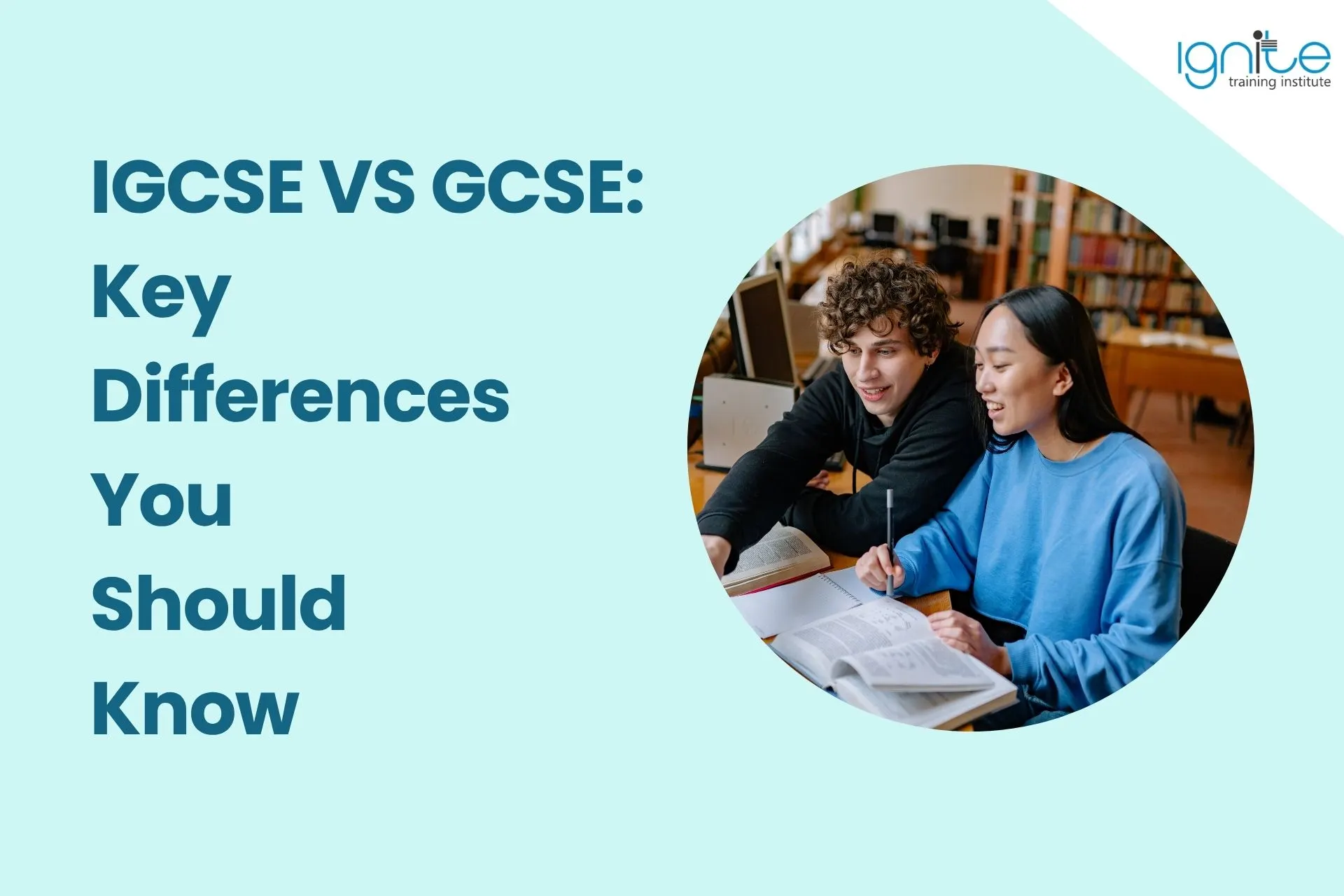
Key Summary
- Same Family, Different Audiences: IGCSE is the international version of the UK’s GCSE qualification, with both designed for students aged 14 to 16.
- Equivalent For University Entry: UK universities, including all Russell Group institutions, treat IGCSE and GCSE as equal for admissions.
- Major 2024 Regulatory Shift: Cambridge IGCSE is no longer Ofqual-regulated as of December 2024, while Pearson Edexcel International GCSE remains regulated.
- Assessment Gap Has Narrowed: After the 2017 GCSE reforms in England, both qualifications are now largely exam-based, removing most of the old coursework divide.
- IGCSE Dominates Dubai Schools: Most British-curriculum schools in Dubai deliver IGCSE rather than domestic GCSE, making it the default choice for UAE families.
Walk into any Year 9 parent meeting at a British-curriculum school in Dubai, and the same question keeps coming up: should my child be on IGCSE or GCSE, and does it actually make a difference? Most families assume they are completely separate qualifications.
In reality, they sit on the same academic level and are accepted as equivalent by universities, but the differences in exam boards, assessment style, regulation, and curriculum focus are worth understanding before subject selection in Year 10.
This guide covers the seven differences that genuinely matter in 2026, including the December 2024 Cambridge International regulatory change that most older blogs have not updated. If you are looking for structured exam preparation, our IGCSE tutors in Dubai work with students across Cambridge CAIE, Pearson Edexcel, and OxfordAQA boards.
What Is IGCSE vs GCSE? A Quick Definition
Before going into the differences, it helps to be clear on what each acronym actually means and where they sit in the broader British education pathway. Both qualifications are taken at the end of compulsory secondary schooling and feed into either A-Levels, the IB Diploma, or other pre-university routes.
What Does IGCSE Stand For?
IGCSE stands for International General Certificate of Secondary Education. It was developed by Cambridge International Education in 1988 as the international counterpart to the UK GCSE, and is now offered in more than 150 countries.
Three main exam boards run versions of it today: Cambridge CAIE, Pearson Edexcel, and OxfordAQA. The qualification is taken subject by subject, with students typically sitting between five and ten IGCSEs.
What Does GCSE Stand For?
GCSE stands for General Certificate of Secondary Education. It is the standard qualification taken by students in England, Wales, and Northern Ireland, usually at the end of Year 11 when they are around 16 years old. GCSEs are set by UK domestic exam boards including AQA, Pearson Edexcel, OCR, and WJEC, and they are tied closely to the UK national curriculum.
Quick Answer: IGCSE is the international version of the GCSE, designed for students aged 14 to 16. Both are pre-A-Level qualifications, both run over two years, and both are accepted by UK universities as equivalent.
The real differences sit in the exam boards, curriculum focus, exam sessions per year, and regulatory status in the UK.
Know More About: What Is IGCSE Curriculum: A Complete 2025 Overview
IGCSE vs GCSE at a Glance: A Side-by-Side Comparison
The table below sets out the practical differences between the two qualifications. This is the cleanest way to see where they overlap and where they diverge.
| Feature | IGCSE | GCSE |
| Full name | International General Certificate of Secondary Education | General Certificate of Secondary Education |
| Primary audience | International students, expat families, private candidates | UK domestic students in England, Wales, Northern Ireland |
| Where it is taught | Over 150 countries including UAE, India, Singapore, Hong Kong | Mainly the UK, with some availability in Australia, Canada, and India |
| Exam boards | Cambridge CAIE, Pearson Edexcel, OxfordAQA | AQA, Pearson Edexcel, OCR, WJEC |
| Grading scale | Cambridge uses A*–G; Pearson Edexcel and reformed Cambridge use 9–1 | 9–1 across all subjects (since 2017–2019 rollout) |
| Coursework | Minimal to none in most subjects; some practical components | Mostly removed after 2017 reforms; some practicals remain |
| Exam sessions per year | Two to three (May/June, October/November, plus February/March for India) | One main session in May/June, with November resits for English and Maths |
| UK Ofqual regulation | Cambridge IGCSE deregulated December 2024; Pearson Edexcel International GCSE still regulated | Fully regulated by Ofqual |
| Typical year group | Year 10 to Year 11 (ages 14–16) | Year 10 to Year 11 (ages 14–16) |
| University recognition | Accepted by UK, US, Australian, and Canadian universities including Russell Group | Accepted by UK, US, Australian, and Canadian universities including Russell Group |
Know More About: Pearson Edexcel IGCSE: Subjects, Grades, & Popular Facts
7 Key Differences Between IGCSE & GCSE
The two qualifications look almost identical from a distance, but seven specific differences shape how each one is taught, assessed, and recognized. Some of these have shifted noticeably in the last few years, which is why older comparison articles can be misleading.
1. Audience and Where They Are Taught
GCSEs are intended for students in the United Kingdom, with the majority of state and independent schools in England, Wales, and Northern Ireland adhering to them. IGCSEs serve an international audience and are the standard offering at British-curriculum schools outside the UK.
In Dubai, almost every KHDA-regulated British school delivers IGCSE rather than the domestic GCSE, since the international syllabus suits a globally mobile student body better.
2. Exam Boards Behind Each Qualification
GCSEs in the UK are awarded by AQA, Pearson Edexcel, OCR, and WJEC. IGCSEs are offered by three boards: Cambridge CAIE (the largest, with over 70 subjects), Pearson Edexcel International, and OxfordAQA, which is a joint venture between AQA and Oxford University Press.
The board your school uses affects question style, paper structure, and even which subjects are available, so it is worth knowing this before exam preparation begins.
3. Grading Scales: 9–1 vs A*–G
GCSEs in England moved from the A*–G scale to the 9–1 numerical scale between 2017 and 2019, with 9 as the highest grade and 4 as a standard pass. IGCSE grading is split. The Cambridge IGCSE continues to employ the A*–G grading system in the majority of countries, while the 9–1 scale is offered as an alternative for select subjects and areas.
Pearson Edexcel International GCSE has fully moved to the 9–1 scale across all subjects. This split means a Dubai student sitting Cambridge IGCSE Maths and another sitting Pearson Edexcel IGCSE Maths could end up with grades on different scales for the same level of work.
4. Assessment Style and Coursework
This is the difference that has changed the most. For years, IGCSE was described as more exam-heavy than GCSE because GCSE included significant coursework. The 2017 GCSE reforms removed most of that coursework, and final exams now decide grades in nearly every UK GCSE subject.
Both qualifications are now largely terminal-exam-based, with practical components surviving in subjects like Science, Art, and Geography. Anyone reading an older comparison should be cautious of claims that GCSE is the coursework-heavy option; that has not been broadly true since 2017.
5. Curriculum Focus: International vs UK National Curriculum
GCSEs are built around the UK national curriculum, which means specific cultural and geographic anchors. GCSE English Literature, for example, requires students to study Shakespeare. GCSE History and Geography pull heavily from British contexts.
IGCSEs were designed to be culturally neutral, with broader literary choices, more globally relevant case studies, and source material that does not assume prior knowledge of UK life. For a student in Dubai studying English Literature, an IGCSE syllabus offering African, Caribbean, and Asian writers alongside British ones is often more engaging than a UK-centric reading list.
6. Exam Sessions and Flexibility
GCSE exams run once a year in May and June, with November resit opportunities limited mainly to English and Maths. IGCSE offers more flexibility. Cambridge CAIE runs three sessions: May/June, October/November, and February/March for India.
Pearson Edexcel International runs June and November sessions, having phased out the January exam window from 2023. The extra sessions matter for students who relocate mid-year, for private candidates, and for anyone who needs to resit a subject without losing a full academic year.
7. Ofqual Regulation Status in 2026
This is the most significant recent change. Cambridge International Education surrendered its Ofqual recognition on 20 December 2024, meaning Cambridge IGCSE is no longer regulated by the UK exams watchdog. Pearson Edexcel International GCSE remains Ofqual-regulated. In practice, this does not affect the academic standing of Cambridge IGCSE or its acceptance by universities, since universities assess applicants on grades and subjects rather than regulatory status.
But it does mean Pearson Edexcel International GCSE is now the only IGCSE board still regulated alongside UK domestic GCSEs, which is a useful detail for families weighing one board against another.
Know More About: What Is The Difference Between Edexcel & Cambridge? 5 Facts
Is IGCSE Harder Than GCSE?
This is the single most asked question on the topic, and the honest answer is that neither is systematically harder than the other. The perception of difficulty comes from history rather than current reality.
Where the Difficulty Myth Comes From?
Before 2017, IGCSEs felt harder because they relied on final exams while GCSEs included coursework that students could build up over time. Many British independent schools historically chose IGCSE precisely because they considered it more rigorous preparation for A-Levels. With coursework now mostly removed from GCSEs, that historical gap has largely closed.
Difficulty today depends much more on the specific subject, the exam board, and the school than on whether the certificate says IGCSE or GCSE.
IGCSE Maths vs GCSE Maths
Maths is the subject where the difficulty debate runs hardest. Cambridge IGCSE Maths (0580) and Pearson Edexcel IGCSE Maths A both cover algebra, geometry, statistics, and probability at a level broadly comparable to GCSE Higher tier.
IGCSE Maths is sometimes considered harder because it leans more toward exam-only assessment and includes some content that overlaps with early A-Level work. GCSE Higher tier is no longer significantly easier in content; the main difference is exam style and question phrasing. Strong preparation matters more than the qualification label.
What Universities Actually Say?
Russell Group universities, including Oxford and Cambridge, have publicly confirmed they make no distinction between IGCSEs and GCSEs when assessing applicants. US universities, including Ivy League institutions, also accept both.
The grades, the subjects chosen, and the overall academic profile matter far more than which version of the qualification appears on a student’s certificate.
Know More About: How To Find The Best Coaching Institute In Dubai?
Which One Should You Choose? A Practical Decision Framework
In most cases, the choice is made by the school, not the student. But for families who do have a choice, especially homeschoolers, private candidates, or those changing schools, the decision usually comes down to five practical questions.
- If your child is at a UK state or private school in Britain: GCSE is almost always the default. Some independent schools offer IGCSE, but the school decides which subjects use which qualification.
- If your child is at an international school in Dubai, Singapore, Hong Kong, or India: IGCSE is the standard offering. The board (Cambridge, Pearson Edexcel, or OxfordAQA) is set by the school.
- If you are homeschooling or sitting as a private candidate: IGCSE is usually the better fit because of more flexible exam sessions and a wider network of approved international exam centres.
- If you are applying to UK universities: Either qualification works equally well. Focus on strong grades in core subjects.
- If your family is likely to relocate mid-study: IGCSE is more portable. The same syllabus can be picked up in a new country, and multiple exam sessions per year reduce the risk of losing an academic year.
Know More About: List Of Best-Reviewed IGCSE Schools In Dubai
IGCSE vs GCSE In Dubai: What This Means For UAE Students
For families in Dubai, the distinction between IGCSE and GCSE is infrequently a true choice. The British-curriculum schools regulated by the KHDA almost exclusively offer IGCSE rather than domestic GCSE. This is partly because IGCSE was built for international audiences, partly because the multiple exam sessions match the international school calendar better, and partly because the syllabus content avoids assuming UK cultural and historical knowledge.
Cambridge IGCSE has been the dominant board in Dubai schools for years, although Pearson Edexcel International GCSE has been growing steadily, particularly in newer schools that want continuity with Pearson’s A-Level offering.
A small number of schools also offer OxfordAQA. If your school offers a choice between boards for a particular subject, the practical question is which paper style suits your child better, rather than which board has the stronger reputation. All three are accepted equally by universities.
Transferring between schools mid-year is also more straightforward with IGCSE. A student moving from a Dubai school to a UK independent school, for instance, can often continue on the same IGCSE syllabus rather than switching to GCSE, since many UK private schools now teach IGCSEs alongside GCSEs.
Know More About: British Curriculum Explained: A Complete Guide
Ignite – IGCSE Tutors In Dubai Supporting Your Exam Journey
Whether your child is on Cambridge, Pearson Edexcel, or OxfordAQA, the structure of preparation matters more than the choice of qualification. At Ignite Training Institute, our IGCSE tutors in Dubai work board by board, building study plans around the specific syllabus, paper structure, and mark scheme of the exam board your school follows.
We focus on past paper practice, command word recognition, and the differences in how each board phrases questions, since these are the details that separate a 7 from a 9 in IGCSE Maths or an A from an A* in Cambridge English. For students transitioning into A-Levels after IGCSE, we also offer British curriculum tutors in Dubai who carry the same structured approach into Years 12 and 13.
FAQs
1. Is IGCSE The Same As GCSE?
They are equivalent qualifications but not identical. Both sit at the same academic level, both are taken between ages 14 and 16, and UK universities treat them as equal for admissions.
The differences come down to exam boards, where each is taught, curriculum focus, and the number of exam sessions per year. Think of IGCSE as the international cousin of GCSE, built for students outside the UK.
2. Is IGCSE Maths Harder Than GCSE Maths?
Topic coverage is broadly similar between IGCSE Maths and GCSE Higher tier. IGCSE Maths has historically been perceived as harder because of its exam-only assessment style and slightly broader content in algebra and probability.
After the 2017 GCSE reforms removed coursework, that gap is narrower than it used to be. For a strong student, both are demanding; for any student, consistent past paper practice matters more than the qualification name.
3. Do Universities Prefer IGCSE Or GCSE?
Neither. Russell Group universities have stated publicly that they do not distinguish between IGCSE and GCSE when reviewing applications. The same applies to Oxford, Cambridge, all UK universities, and US universities including the Ivy League. What matters is the grades achieved, the subject combination, and the strength of the wider application.
4. Can A Student Switch From IGCSE To GCSE (Or Vice Versa) Mid-Course?
Yes, switching is possible and reasonably common, but timing matters. Moving between the two in Year 9 or early Year 10 is straightforward because content overlap is high and there is time to adjust.
Switching closer to exams becomes more difficult because of differences in set texts, specific case studies, and coursework requirements in some subjects. Always confirm with the new school which exam board and syllabus they follow before finalizing the move.
5. What Is The IGCSE Equivalent In Other Countries?
IGCSE is recognized as equivalent to the UK GCSE, US high school 10th grade completion, Cambridge O Level in several Commonwealth countries, and India’s Class 10 board exams (CBSE, ICSE).
It serves as a stepping stone to A-Levels, the IB Diploma Programme, AP courses, or other pre-university qualifications, regardless of which country the student moves into next.
6. Which IGCSE Exam Board Is Best For Students In Dubai?
Cambridge CAIE is the most widely offered board in Dubai schools, followed by Pearson Edexcel International GCSE. OxfordAQA is available in a smaller number of schools. The honest answer is that the best board is the one your school already offers, since teaching, resources, and past papers will be aligned to it. If you have a genuine choice, the deciding factor is usually which paper style and question approach suits your child’s strengths.
Conclusion

IGCSE and GCSE sit at the same academic level, lead to the same destinations, and are treated as equivalent by every UK university worth applying to. The real differences are practical: which exam board is behind the qualification, whether it carries Ofqual regulation, how many exam sessions are offered each year, and how international the syllabus content feels. For families in Dubai, the decision is usually made by the school, and IGCSE is the standard offering across British-curriculum institutions in the UAE.
What matters most is how well a student is prepared for the specific board and subject they are sitting, rather than which version of the qualification appears on the certificate. If you would like a structured plan tailored to your child’s exam board and target grades, book a free demo class with one of our IGCSE subject specialists.
Know More About: IGCSE VS CBSE: Ultimate Comparison With 6 Key Differences

Categories:
August 5


Cambridge IGCSE Physics 0625: Syllabus & Past Papers
August 5
Cambridge IGCSE Biology: Syllabus, Grading & Resources
August 5