 Call
Call Whatsapp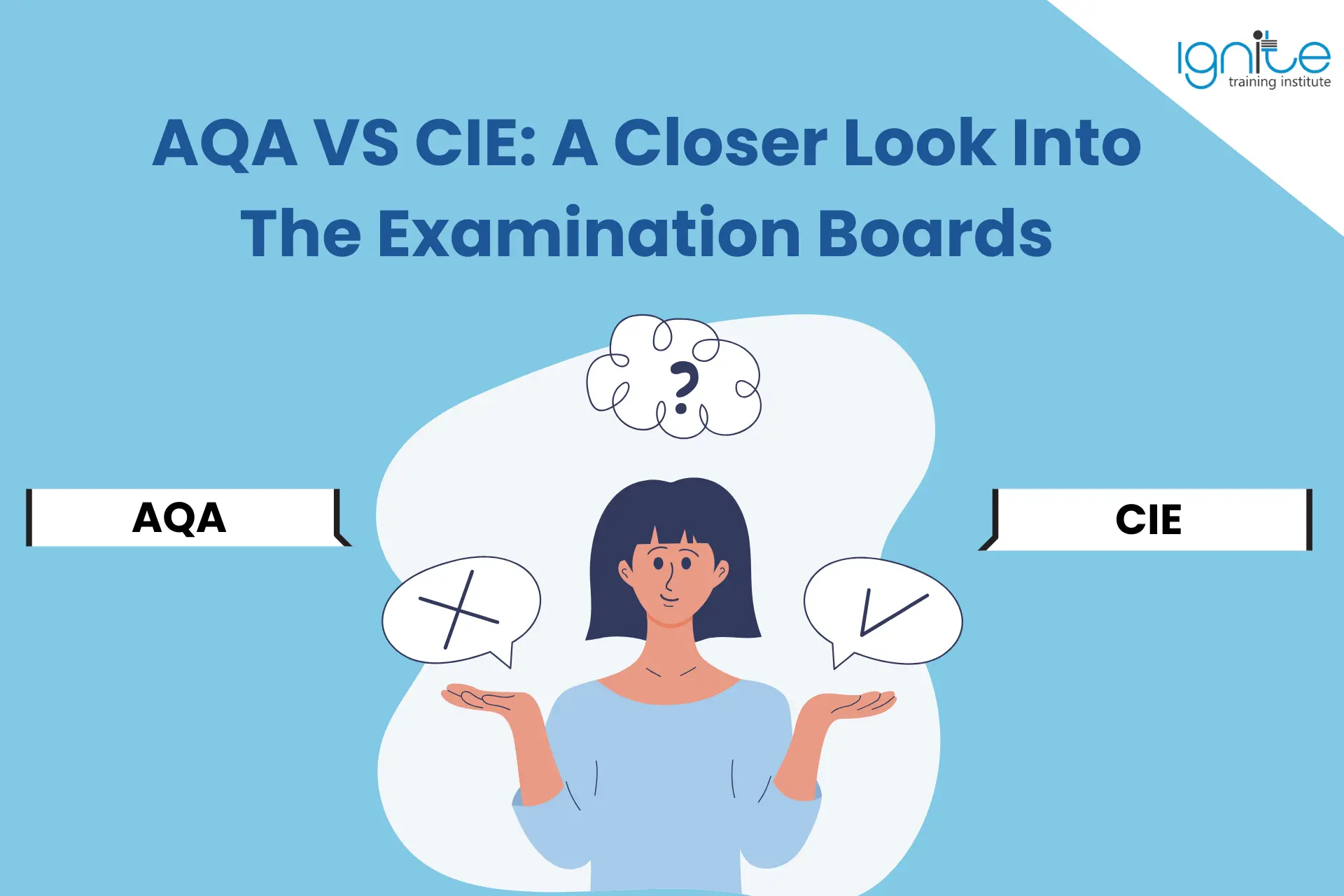
Key Summary
- Two Different Boards, Confusing Names: Outside the UK, “AQA” almost always means Oxford AQA, while “CIE” is the older name for what is now Cambridge International Education.
- Assessment Style Differs: Oxford AQA builds exams around fair, subject-focused questions with simpler language, while Cambridge offers tiered Core and Extended papers for many subjects.
- Grading Is Not Identical: Oxford AQA International GCSEs use 9 to 1, while Cambridge IGCSE in the UAE lets schools pick either 9 to 1 or A* to G.
- The 2026 UAE Exam Change Matters: Cambridge moved its June 2026 UAE exams to portfolio submission instead of sit-down papers, which directly affects students this year.
- Your School Usually Decides First: Most UAE students do not freely pick a board; the school sets it, so the real question is how to do well on the one you have.
Walk into any conversation about British curriculum exams in Dubai, and you will hear AQA, Oxford AQA, CIE, CAIE, and Cambridge used as if they all mean the same thing. They do not, and that confusion is exactly why so many students and parents struggle to make a clear decision. The names overlap, the marketing sounds similar, and most articles online add to the noise instead of clearing it.
This guide fixes that. It explains what AQA and CIE actually are, how they really differ in assessment and grading, what changed for UAE students in 2026, and how to choose between them with a simple framework. Everything here is checked against official board and British Council sources, not guesswork.
At Ignite Training Institute, we tutor students across both boards every term, so this comparison comes from real exam-prep experience with IGCSE and A-Level students in the UAE, not just published specifications.
What Are AQA And CIE?
AQA and CIE are two separate examination boards offering British curriculum qualifications. Internationally, “AQA” usually refers to Oxford AQA, a partnership between Oxford University Press and AQA that creates International GCSEs and A-Levels for students outside the UK.
“CIE” is the older name for Cambridge International Education, part of Cambridge University Press and Assessment, which runs Cambridge IGCSE and Cambridge International AS and A Level. They are different organisations, with different exam styles and grading choices.
What AQA (Oxford AQA) Actually Is?
The plain AQA board is the largest provider of GCSEs and A-Levels in the UK. For international students, AQA delivers qualifications through Oxford AQA, a joint venture between Oxford University Press (a department of the University of Oxford) and AQA.
Oxford AQA offers International GCSEs, AS and A-Levels designed for students aged roughly 14 to 19 worldwide, and these are benchmarked to UK standards and independently checked by UK ENIC as being the same standard as UK GCSEs and A-Levels.
One detail many UAE families miss: when a Dubai school says it follows “AQA” for IGCSE or A-Level, it almost always means Oxford AQA, not the UK domestic AQA board. If you want a deeper breakdown, our guide on what Oxford International AQA is covers it in detail.
What CIE (Cambridge International Examinations) Actually Is?
CIE stands for Cambridge International Examinations, the assessment body founded in 1858 as the University of Cambridge Local Examinations Syndicate. The naming has changed over time, which is a big source of confusion.
CIE became CAIE (Cambridge Assessment International Education) around October 2017, and in October 2023, the organisation rebranded again to Cambridge International Education. So CIE, CAIE, and Cambridge International all point to the same board.
Cambridge International offers Cambridge IGCSE, Cambridge O Level, and Cambridge International AS and A Level, used in more than 160 countries. For a fuller picture of how the Cambridge system works, see our Cambridge curriculum guide.
Is AQA The Same As Cambridge?
No. AQA and Cambridge are completely separate boards run by different organisations. The mix-up usually happens because both are major British curriculum providers and both offer IGCSEs and A-Levels. Oxford AQA comes from Oxford University Press and AQA; Cambridge International comes from Cambridge University Press and Assessment.
A student takes either Oxford AQA exams or Cambridge exams for a given subject, not both, and the choice is normally set by the school rather than the student.
Know More About: What Is AQA GCSE: A Detailed Overview For Students & Parents
AQA VS CIE: The Core Differences That Actually Matter
Both boards lead to globally recognised qualifications, so the real question is how they differ in day-to-day exam terms. The table below summarises the differences that affect students most, and each point is expanded underneath.
| Factor | Oxford AQA (AQA) | CIE (Cambridge International) |
| Who runs it | Oxford University Press and AQA partnership | Cambridge University Press and Assessment |
| Main qualifications | International GCSE, AS, A-Level | Cambridge IGCSE, O Level, International AS and A Level |
| Assessment style | Subject-focused questions, simpler language, reduced cultural bias | Tiered Core and Extended papers in many IGCSE subjects |
| IGCSE grading | 9 to 1 | 9 to 1 or A* to G (UAE schools choose) |
| AS and A-Level grading | A to E (AS), A* to E (A-Level) | A to E (AS), A* to E (A-Level) |
| Global reach | Fastest growing international board, expanding subject list | Used in 160+ countries, very widely offered in UAE schools |
| UAE exam sessions | Around three times a year (January; May/June) | May/June and October/November (Feb/March is India only) |
Sources for the table: Oxford AQA,British Council UAE on Oxford AQA exams, and British Council UAE on IGCSE exam reforms and grading.
1. Assessment Style And Exam Design
Oxford AQA is built around a fair, subject-based assessment idea. Its exams are written to test what a student knows in the subject, using clearer language and removing unnecessary cultural context, so students who speak English as a second language are not disadvantaged.
Cambridge takes a different route in many IGCSE subjects by offering tiered papers, usually Core and Extended, so the exam can be matched to a student’s ability level.
In practice, this means an Oxford AQA paper tends to feel more linguistically accessible, while Cambridge gives a structured way to stretch stronger students or support those who need a more achievable target through tiering.
2. Grading Systems (9 to 1 vs A* to G, And What UAE Schools Use)
This is where many parents get tripped up. Oxford AQA International GCSEs use the 9 to 1 grading scale, the same numeric system used by reformed GCSEs in England. Cambridge IGCSE is more flexible: in Administrative Zone 3, which includes the UAE and Oman, schools can choose either 9 to 1 or A* to G grades, and the 9 to 1 syllabuses have exactly the same content and assessment as their A* to G versions.
For AS and A-Level, both boards keep letter grades, with AS graded A to E and A-Level graded A* to E. If grade scales are confusing, our breakdown of how IGCSE grades work explains each system clearly.
3. Subject Range And Curriculum Approach
Cambridge has a very broad subject catalogue built over decades and is one of the most widely offered international systems in UAE schools. Oxford AQA has a smaller but rapidly expanding range and has continued adding new International GCSEs and A-Levels, positioning itself as the fastest growing international exam board.
Both cover the core academic subjects most UAE students need for university, so subject availability usually comes down to what your specific school offers rather than the board in the abstract.
4. Global Recognition And University Acceptance
Both qualifications are accepted by leading universities worldwide, including UK Russell Group universities and top institutions in the US, Europe and the Middle East.
Oxford AQA qualifications are benchmarked to UK standards and recognised internationally, and Cambridge has a long global track record across 160+ countries.
For students comparing British boards more broadly, our guide on the difference between Edexcel and Cambridge is a useful companion read. In short, recognition is rarely the deciding factor; both open the same doors.
Know More About: Top Universities That Accept IGCSE Certificate In USA & UK
AQA VS CIE In The UAE: What Dubai Students Need To Know In 2026?
The UAE context changes the AQA vs CIE decision in ways that UK-focused articles miss entirely. Exam delivery, session timing, and school adoption all work differently here, and 2026 brought a major change for Cambridge students specifically.
The June 2026 Cambridge Exam Change In The UAE
In a significant shift, Cambridge cancelled its June 2026 sit-down exams in the UAE for Cambridge IGCSE, Cambridge O Level, Cambridge International AS and A Level, and the Cambridge IPQ, in coordination with the UAE Ministry of Education.
Instead of writing papers in school, affected candidates submit portfolios of work to be marked and graded by Cambridge, and Cambridge confirmed there would be no return to traditional exams for UAE schools within that June 2026 series, as reported by Gulf News in April 2026.
If you are a Cambridge student in the UAE this year, it is essential to verify this single most important factor with your school prior to concerning yourself with board comparisons.
Exam Sessions And Resit Timing In Dubai
Session timing affects how quickly you can resit and still meet university deadlines. Oxford AQA exams are offered in Dubai around three times a year, including a January session for AS and A-Level and a May/June session for IGCSE plus AS and A-Level. Cambridge runs May/June and October/November series internationally, with the February/March series available for India only.
More session points generally means more chances to improve a grade sooner, which can matter for UCAS and other application timelines.
Which Boards UAE/British Curriculum Schools Typically Offer?
Cambridge is one of the most widely offered international systems in the UAE and is especially common in British curriculum schools, with a large number of UAE schools running Cambridge programmes. Oxford AQA is growing and is available to private candidates through British Council UAE, but Cambridge still has the wider footprint locally.
This is why, for most families, the practical question is not “which board is better in theory” but “which board does my school use, and how do I do well on it”. Our guide on how to study for IGCSE exams is built around exactly that goal.
Know More About: List Of Best-Reviewed IGCSE Schools In Dubai
Is AQA Harder Than CIE? An Honest Answer
There is no reliable evidence that one board is universally harder than the other, and the AQA and CIE syllabuses are not the same. They cover similar core knowledge for a given subject but differ in structure, question style, and assessment design, so “harder” depends on the subject and the student.
A UK Department for Education comparison of GCSEs and International GCSEs found it was easier to achieve a top grade in English language and literature on International GCSEs, but harder in maths and science, with most other subjects roughly equivalent. That tells you difficulty varies by subject, not by board label.
A student strong in extended writing may find one board’s paper more comfortable, while a student who prefers structured, tiered questions may prefer the other. The honest answer is to look at the specific subject specification and past papers rather than chasing a blanket “easier board”.
Know More About: 10 Easiest IGCSE Subjects In 2025 For Academic Excellence
How To Choose Between AQA And CIE?

If you genuinely have a choice, here is a simple way to decide instead of relying on vague advice.
1. Choose Based On Your School And Target Universities
In the majority of schools in the UAE, the curriculum is set for each subject, therefore it is essential to verify what your school provides before proceeding with any other considerations.
If you do have a choice, remember both boards are accepted by top universities worldwide, so this factor rarely separates them. Decide based on the next two points instead.
2. Choose Based On Assessment Style And English Support
If English is an additional language or you want exams that minimise cultural and language barriers, Oxford AQA’s fair-assessment design is a genuine advantage.
If you want the option to match paper difficulty to ability through Core and Extended tiering, Cambridge’s tiered structure is helpful. Match the board’s exam style to how you actually perform under exam conditions.
3. Choose Based On Resit Flexibility And Timelines
If you may need to resit and still hit university deadlines, more exam sessions help. Oxford AQA’s roughly three sessions a year, including January, can speed up a resit compared with waiting for the next main series.
For 2026 specifically, factor in the Cambridge UAE portfolio change before assuming a standard exam timeline.
Know More About: Is O Level And IGCSE The Same? Differences & How To Choose
Ignite: British Curriculum Tutors In Dubai Supporting AQA And CIE Students
At Ignite Training Institute, we work with British curriculum students preparing for both Oxford AQA and Cambridge exams, so our tutoring is matched to the exact board and specification a student is sitting, not a generic British curriculum overview. That means board-specific past paper practice, mark scheme familiarity, and exam technique built around how each board actually assesses.
One example of this in practice: a student who studied with us across IGCSE Science and Maths and then IB went on to secure offers from UCL and the University of Edinburgh after roughly three years of structured tutoring. Results like that come from consistent, board-aware preparation rather than last-minute cramming.
Whether your school follows Cambridge IGCSE or you are preparing for A-Levels, our tutors focus on building genuine subject confidence and exam readiness.
FAQs
1. Is AQA The Same As CIE Or Cambridge?
No. AQA and CIE (Cambridge International) are separate examination boards run by different organisations. Internationally, AQA usually means Oxford AQA, a partnership between Oxford University Press and AQA.
CIE is the older name for Cambridge International Education, part of Cambridge University Press and Assessment. They are not interchangeable.
2. Is AQA Harder Than CIE?
There is no solid evidence that one board is harder overall. Difficulty depends on the subject and the student.
A UK Department for Education study found International GCSEs were easier for a top grade in English but harder in maths and science compared with UK GCSEs, which shows difficulty varies by subject, not by board.
3. Is The AQA And CIE Syllabus The Same?
No. The two boards cover similar core knowledge for a subject but use different syllabus structures, question styles, and assessment designs.
Oxford AQA focuses on fair, subject-based assessment, while Cambridge offers tiered Core and Extended papers in many IGCSE subjects. Always check the specific subject specification.
4. Which Is Better For UAE Students, AQA Or CIE?
For most UAE students, the school already sets the board per subject, so the better question is how to perform well on the one you have.
If you do have a choice, Oxford AQA suits students wanting language-fair assessment, while Cambridge offers tiering and a very wide subject range with a strong UAE school presence.
5. Are AQA And CIE Equally Accepted By Universities?
Yes, in practical terms. Both Oxford AQA and Cambridge qualifications are recognised by leading universities worldwide, including UK Russell Group institutions and top universities in the US, Europe, and the Middle East. University recognition is rarely the deciding factor between them.
6. Can I Switch Between AQA And CIE?
It is possible, but it depends on your school and the subject. Because syllabus structure and assessment differ, switching mid-course can mean adjusting to a different paper style. If a switch is being considered, plan it with enough preparation time and board-specific practice to adapt to the new exam format.
Conclusion

AQA and CIE are separate boards, and the first step is simply knowing that “AQA” usually means Oxford AQA and “CIE” means Cambridge International. From there, the differences that matter are assessment style, grading choice, and, for UAE students in 2026, the Cambridge exam delivery change. Neither board is universally harder, and both are widely accepted by top universities.
For most families, the practical decision is set by the school, so the real win is strong, board-aware preparation. If you want clarity on which board your child is sitting and a structured plan to perform well on it, book a free demo class or speak with an academic advisor at Ignite.
Know More About: What Is Oxford International AQA? All You Need To Know

Categories:
August 26


Edexcel A Level Chemistry: Syllabus, Grades & Resources
August 26
Edexcel A Level Physics: Syllabus & Key Resources
August 5