 Call
Call Whatsapp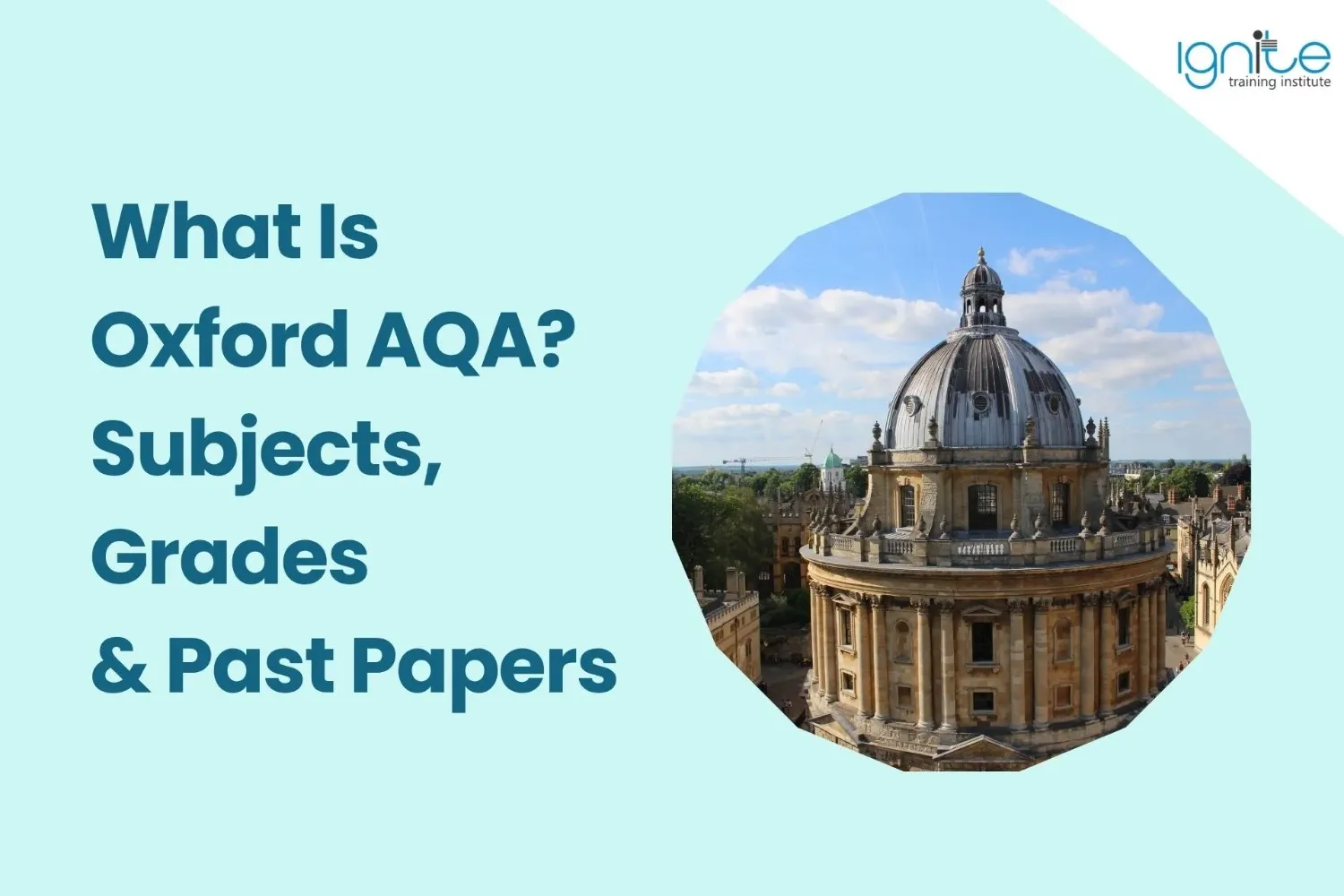
Key Summary
- Joint Oxford & AQA Board: OxfordAQA is run by Oxford University Press and AQA, offering International GCSE, AS and A-Level qualifications for students aged 14 to 19.
- Built For International Students: Its papers use clear English and avoid cultural bias, so students are marked on subject knowledge rather than language or background.
- Wide Subject Range: Choices span sciences, mathematics, business and languages, including newer options like Arabic First Language and Global Skills Projects.
- Three UAE Exam Windows: In Dubai, exams run in November, January and May/June, and private candidates can register through the British Council.
- Clear Grades & Past Papers: International GCSEs use the 9 to 1 scale, A-Levels use A* to E, and grade boundaries plus specimen papers are published on the official site each series.
If your school in the UAE uses OxfordAQA, or you are weighing it against Cambridge and Edexcel, the name alone can be confusing. It looks like AQA, the familiar British board, but it is not quite the same thing, and the differences shape how your child is taught, examined and graded.
This guide explains what OxfordAQA actually is, the subjects and exam codes it offers, how its grade boundaries and past papers work, and where students sit the exams in Dubai. At Ignite Training Institute, we support IGCSE and A-Level students through these qualifications every term, so the advice here comes from real classroom work, not a brochure.
What Is OxfordAQA?
OxfordAQA is an international exam board created by Oxford University Press and AQA, the UK’s largest provider of GCSEs and A-Levels. It offers International GCSE, AS and A-Level qualifications for students aged 14 to 19, benchmarked to UK standards but written in clear English so learners are assessed on subject knowledge rather than language fluency.
The core idea is fairness. Questions avoid idioms, slang and cultural references that would trip up a student who did not grow up in Britain. A learner in Dubai, Lagos or Karachi is tested on whether they understand the subject, not on whether they recognise a British cultural reference.
The board is a partnership backed by over a century of assessment experience, and it is led by managing director Andrew Coombe. Its qualifications are recognised by universities in the UK, the US, Canada, and beyond, which is a large part of why so many international schools have adopted them.
Know More About: What Is AQA GCSE: A Detailed Overview For Students & Parents
OxfordAQA Subjects & Qualifications
OxfordAQA covers a broad academic range across three levels: International GCSE, International AS, and International A-Level. Every subject has its own code, which you will see on entry forms and past papers, so it helps to recognise the main ones.
International GCSE Subjects & Codes
Popular International GCSE options and their codes include:
- Mathematics (9260)
- Biology (9201), Chemistry (9202), Physics (9203) and Combined Science (9204)
- Business (9225), Economics (9214) and Accounting (9215)
- English Language (9270), English Literature (9275) and English as a Second Language (9280)
- Computer Science (9210), Geography (9230) and Psychology (9218)
- Languages such as French (9265) and Spanish (9269)
OxfordAQA offers around 30 International GCSE subjects in total. This includes a CORE science tier (Core Biology 9221, Core Chemistry 9222 and Core Physics 9223) and Core English as a Second Language (9285), which give a more accessible route for some students. You can browse the full range on the official OxfordAQA subjects page.
International AS And A-Level Subjects & Codes
At the advanced level, common subjects and codes include:
- Mathematics (9660) and Further Mathematics (9665)
- Biology (9610), Chemistry (9620), and Physics (9630)
- Business (9625), Economics (9640), and Accounting (9615)
- Computer Science (9645), Psychology (9685), and Sociology (9690)
- English Language (9670) and English Literature (9675)
There is also the International EPQ (9695), a standalone research qualification that universities value for showing independent study skills.
New Qualifications Added In 2025
In September 2025, OxfordAQA launched seven new qualifications. Five are International GCSEs in History, Chinese First Language, Arabic First Language, Sociology and Global Skills Projects, and two are International A-Levels in Chinese First Language and Sociology.
The Arabic First Language IGCSE is especially relevant for families in the Gulf, while the Global Skills Projects qualification uses a project based approach built around sustainability and real world problem solving.
Know More About: Easiest IGCSE Subjects: Pass Rates, Picks & Cautions 2026
How OxfordAQA Differs From AQA, Cambridge & Edexcel?
Students often mix up OxfordAQA with standard AQA, and parents want to know how it compares with Cambridge and Pearson Edexcel. They share British academic roots, but there are real differences in who they serve and how they assess.
| Feature | OxfordAQA | AQA (UK) |
| Designed for | International students worldwide | Students in UK schools and colleges |
| Language in exams | Clear, idiom free English | Standard UK English with cultural context |
| A-Level structure | Modular, individual units can be re-sat | Linear, exams sat at the end |
| Exam sessions | November, January and May/June by level | Mainly May/June, occasionally January |
| Recognition | Universities worldwide | Universities worldwide, UK focused |
Against Cambridge and Edexcel, the standout features are the fair assessment design and the modular A-Level structure. Unlike standard AQA and Cambridge International A-Levels, which are linear, OxfordAQA A-Levels are built from units that can be taken across different series, so a student can re-sit a single unit instead of the whole subject. If you are also comparing those two boards, our guide to the differences between Edexcel and Cambridge breaks them down in detail.
Know More About: How To Get Into Oxford University: 2026 Admissions Guide
OxfordAQA Exams In The UAE: Sessions & Private Candidates
For families in Dubai and across the UAE, the practical question is where and when these exams happen. OxfordAQA is delivered locally through the British Council, which also supports schools that run the qualifications.
In Dubai, the British Council offers OxfordAQA exams across three windows in the year:
- November: International GCSE session
- January: AS and A-Level session
- May/June: International GCSE, AS and A-Level session
Private candidates, including homeschooled students and anyone not entered through a school, can register for OxfordAQA exams directly through the British Council in the UAE.
Entry deadlines change every year, and there are late entry stages that carry extra fees, so confirm the current dates with the British Council or your school well ahead of the normal deadline rather than relying on last year’s schedule.
Know More About: AQA VS CIE: Key Differences & Which Is Better?
OxfordAQA Grade Boundaries Explained
Grade boundaries are the minimum marks needed for each grade, and OxfordAQA sets them after every exam series rather than in advance. Examiners mark the papers first, then use statistical evidence and senior examiner judgement to decide where each grade falls. This protects students: if a paper turns out harder than usual, the boundary drops so nobody is penalised for sitting a tougher version.
At a glance, here is how OxfordAQA grades work at each level:
| Level | Grading Scale | Highest Grade | Minimum Pass | Key Point |
| International GCSE | 9 to 1 | 9 | 4 (standard) | Combined Science is reported as a double grade (9-9 to 1-1) |
| International AS | a to e | a | e | A standalone qualification, often taken before full A-Level |
| International A-Level | A* to E | A* | E | Modular; unit marks are scaled using the Uniform Mark Scale (UMS) |
How OxfordAQA Grading Works?
The grading scales differ by level:
- International GCSE uses the 9 to 1 scale, where 9 is the top grade and 1 the lowest. Combined Science is reported as a double grade, such as 9-9 down to 1-1.
- International A-Levels are graded A* to E, with U meaning unclassified, and AS-Levels use a to e.
- Because A-Levels are modular, marks are converted to a Uniform Mark Scale, so a unit sat in January carries the same value as the same unit sat in the summer.
OxfordAQA publishes two sets of figures each series: subject boundaries for the overall qualification and component boundaries for individual papers. Both appear on results day, and you can download the exact document for your series from the exams admin section of the official site.
Boundaries shift from one series to the next, so always use the file that matches the month and year you sat, never an older one.
Know More About: IGCSE Grades Explained: Grading System, Pass Marks 2026
OxfordAQA Past Papers: What’s Available & How To Use Them?
Past papers are the single most useful revision tool for any OxfordAQA subject, but where you find them depends on what you need. The board separates publicly available materials from secure ones.
Where To Find OxfordAQA Past Papers?
- Specimen papers and sample assessment materials are published openly on the official OxfordAQA resources page for current subjects, so you can study the exact format before exams.
- Full past papers and mark schemes from recent live series are usually held in the secure area, which your school or exam centre accesses through its OxfordAQA login.
- Private candidates should ask their exam centre or tutor to share the relevant papers and mark schemes for practice.
How To Revise With Past Papers?
Doing papers and learning from them are two different things. A method that works well for our students:
- Sit the paper under timed conditions with no notes, exactly as you would in the real exam.
- Mark it yourself against the official mark scheme, paying close attention to command words like describe, explain and evaluate.
- Read the examiner report for that series to see where most candidates lost marks.
- Re-attempt only the questions you got wrong about a week later, so the correction actually sticks.
Know More About: How To Study For IGCSE Biology: A Complete Guide
Ignite: OxfordAQA Tutoring In Dubai For IGCSE & A-Levels
Choosing and sitting an OxfordAQA qualification is rarely just about one exam. It sits inside bigger decisions about university, subject combinations and how much pressure a teenager can carry at once. That is where structured guidance matters more than another stack of worksheets.
At Ignite, our tutors work directly with the OxfordAQA syllabus for both IGCSE and A-Levels, so lessons map to the exact units, command words and mark schemes your child will face. We practise with real specimens and past papers, track progress against grade boundaries, and adjust the plan as exams approach.
One student who studied with us through IGCSE and into IB over three years went on to offers from UCL and the University of Edinburgh, which is the kind of trajectory clear, consistent support is built for.
FAQs
1. Is OxfordAQA The Same As AQA?
No. They share academic standards and the AQA name, but they serve different students. AQA is built for schools in the UK and follows the national curriculum closely. OxfordAQA adapts those standards for international learners, using clearer language and fairer assessment so students outside Britain are judged on subject knowledge rather than cultural familiarity.
2. Is OxfordAQA Recognised By Universities?
Yes. OxfordAQA International GCSEs, AS and A-Levels are benchmarked to UK standards and accepted by universities in the UK, the US, Canada and across the Middle East. Because they meet the same regulatory benchmarks as British qualifications, admissions teams treat them on par with UK GCSEs and A-Levels. Our guide to universities that accept the IGCSE certificate shows how this works in practice.
3. How Many Times A Year Can You Sit OxfordAQA Exams?
It depends on the level. International GCSEs are offered in November and May/June, while AS and A-Levels run in January and May/June. In Dubai, the British Council delivers exams across all three windows. This flexibility, combined with the modular A-Level structure, means students can spread units across series or re-sit a single unit when needed.
4. What Grade Is A Pass In OxfordAQA?
For International GCSE, grade 4 is widely treated as a standard pass and grade 5 as a strong pass on the 9 to 1 scale, in line with UK practice. For A-Levels, E is the minimum pass grade and A* the highest. Many UAE universities and competitive courses ask for higher grades, so always check the entry requirements for your target programme.
5. Where Do I Find OxfordAQA Past Papers And Grade Boundaries?
Both live on the official OxfordAQA website. Grade boundaries for each series are released on results day in the exams admin and results section, while specimen papers sit on each subject page. Full live past papers are usually in the secure centre area, so ask your school or tutor for access if you are revising independently.
Conclusion

OxfordAQA gives international students a genuinely British qualification without the cultural and language barriers that can hold them back. For UAE families, the three exam windows, modular A-Levels and open specimen papers make it a practical and flexible choice.
The basics worth remembering: it is run by Oxford University Press and AQA, International GCSEs use the 9 to 1 scale while A-Levels use A* to E, and the official site holds the current grade boundaries and specimen papers for every subject. Get those right and the qualification feels far less intimidating.
If your child is preparing for OxfordAQA exams and you want a clear plan built around their subjects and target grades, book a free demo class with one of our tutors and we will map out the next steps together.

August 26


Edexcel A Level Chemistry: Syllabus, Grades & Resources
August 26
Edexcel A Level Physics: Syllabus & Key Resources
August 5