

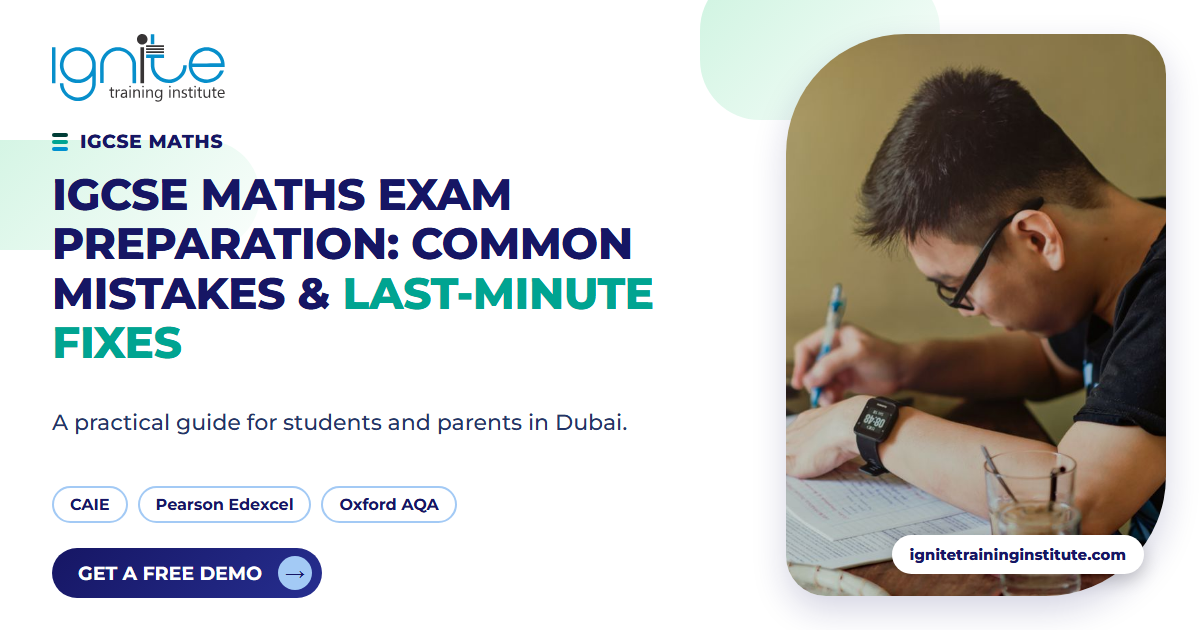
One small mistake in an IGCSE Maths exam can cost marks a student worked hard to earn. A forgotten formula, a misread question, or a calculation slip can pull a grade down, even when the student knows the topic.
The main thing is to understand where the mistakes happen. Simply doing more questions may not help if your child keeps making the same errors. The British Council recommends practising past papers to get familiar with the questions and time limits. It also advises students to check their answers carefully, especially when they finish early.
At Ignite Training Institute, our IGCSE tutors in Dubai help students strengthen their maths skills, practise exam-style questions, and close learning gaps. Parents can also book a free demo class to see how we teach.
In this guide, we’ll cover the common mistakes and the last-minute fixes that can help on exam day.
Key Summary
- Most students lose IGCSE Maths marks because of small mistakes, not hard topics.
- Common slips include missing working, misread questions, sign errors, rounding too early, and poor time use.
- Know your exam board (CAIE, Pearson Edexcel, or Oxford AQA) and your tier, Core or Extended.
- Practice past papers from your own board, and mark them with the mark scheme.
- Keep a mistake list and read it every day.
- Write every step, and check each answer before you finish.
- The day before the exam, revise lightly, pack your bag, and sleep early.
- If you keep repeating the same mistakes, a tutor who knows your board can spot them fast.

Table of Contents
- Common Mistakes That Cost Students Marks with IGCSE Maths
- Last-Minute Fixes for IGCSE Maths Exam Preparation
- How To Make IGCSE Learning Truly Effective
- Ready for Your IGCSE Maths Exam? Start Here
- FAQs
Common Mistakes That Cost Students Marks With IGCSE Maths
Most lost marks come from small, repeat errors, not hard topics. Here are the mistakes examiners see most often, and simple ways to avoid each one.
1. Not showing working
Many students do the steps in their head or on the calculator and write only the final answer. This is risky in Edexcel IGCSE maths, because marks are given for the method as well as the answer. If the answer is wrong and there is no working, all the marks can be lost. Write each step, even the easy ones.

2. Misreading the question
Students often know the method but answer a slightly different question from the one asked. To avoid this:
- Read every question twice before you start.
- Underline key words like “exact,” “to 2 decimal places,” or “show that.”
- Check that your answer matches what was asked, such as the right units.
3. Sign errors
A missing minus sign looks small, but it changes the whole answer. This usually happens when students rush through algebra, brackets, or negative numbers. It can quietly pull down your IGCSE grade, even when you understand the topic. Slow down on these steps, and double-check every sign when you expand brackets or move terms across an equation.
4. Rounding too early
Rounding in the middle of a long calculation makes the final answer less accurate, and accuracy marks are lost. A few simple habits help:
- Keep the full number on your calculator until the last step.
- Round only at the end.
- Give the answer to the accuracy the question asks for.
5. Using the wrong formula or putting in the wrong numbers
Some students pick the wrong formula, while others choose the right one but put the numbers in the wrong places. The IGCSE curriculum includes many formulas, so it helps to practise them with real exam-style questions, not just read them from a list. Write the formula first, then replace each letter with its number. This makes mistakes easy to spot.
6. Poor time management
Some students spend too long on one hard question and then rush the rest of the paper. To stay on track:
- Match your time to the marks. A 3-mark question should not take 10 minutes.
- Skip a question if you are stuck, and come back to it later.
- Keep a few minutes at the end for checking.
7. Not checking answers
Many students finish a paper and put their pen down. But a quick check can catch careless slips. Ask yourself if the answer makes sense. For example, a length cannot be negative, and a probability cannot be more than 1. If these mistakes keep coming back, it may be time to get extra help. Many families choose IGCSE tuition or work with IGCSE maths tutors who can point out the habits a student may not notice alone. IGCSE tutors in Dubai, for example, can use past papers to find the exact mistakes that are costing marks.
Last-Minute Fixes for IGCSE Maths Exam Preparation
With only days left, you cannot learn everything again. But focused steps in your IGCSE Maths exam preparation, matched to your own exam board, can still save marks.
1. Know your exact exam board, paper code and tier
IGCSE Maths is offered mainly by three boards: Cambridge International (CAIE), Pearson Edexcel, and Oxford AQA. Each has its own papers, question style, and syllabus code. For example, CAIE Maths (0580) is built differently from Edexcel IGCSE maths (4MA1). Check with your school which board you are sitting, and whether you are on the Core or Extended tier for CAIE and for Edexcel it could be Foundation or Higher.
Another big difference could be with calculator usage. For example, Edexcel IGCSE allows using a scientific calculator for both papers, but Cambridge IGCSE Maths allows using it only in one of the two papers.
Knowing your paper code is of utmost importance – everything else you revise should match that.
If you need help planning your exam schedule, read our guide to IGCSE exam dates for information on exam sessions across Cambridge, Edexcel and Oxford AQA.
2. Practise past papers from your own board
Sit a full paper in one go, with a timer and no phone. Then mark it with the official mark scheme to see where the marks are given.
- Cambridge (CAIE) students: use CAIE past papers.
- Pearson Edexcel students: use Edexcel past papers.
- Oxford AQA students: use AQA past papers.
Papers from the wrong board can teach you the wrong question style.
3. Make a “mistake list”
Your own errors are the best revision guide. After each paper, write down every mistake and why it happened. For example:
- Forgot to show working
- Rounded too early
- Missed a minus sign
- Misread “to 2 decimal places”
Read the list every day, and again on the morning of the exam.

4. Focus on topics that give the most marks
You do not need to revise every topic equally. Look at your past paper results and the IGCSE curriculum for your board, then pick the topics where you lose marks most often. Algebra, fractions, ratio, and basic geometry come up again and again, so small gains there add up fast. Spend less time on topics you already get right.
5. Learn the formulas you must remember
Check which formulas are given in your exam. This can differ between boards, so look at your own board’s formula list.
- Write the formulas you must remember on one page.
- Cover the page and try to write them from memory.
- Use each one in two or three quick questions, so you know where the numbers go.
6. Show your working and watch your time
Many students know the method but lose marks because steps are missing. Train yourself to write every step, even when a question looks easy. This protects your IGCSE grade, because marks are often given for the method, not just the answer. Then plan your time:
- Give more time to questions with more marks.
- If you are stuck, move on and come back later.
- Keep the last five to ten minutes for checking.
7. Look after yourself
Tired students make careless mistakes. Sleep well, eat properly, and take short breaks while you revise. A calm mind spots a missing sign much faster than a worried one. Do not try to learn new topics the night before. Just read your mistake list and go to bed on time.
8. Get short, focused help
Sometimes you cannot see your own mistakes, however many papers you do. A few sessions with a tutor can help, which is why many families choose IGCSE tuition in the final weeks. Good IGCSE maths tutors will match you to your exact board, then use its past papers and mark schemes to find the habits that cost you marks. At Ignite Training Institute, our IGCSE tutors in Dubai support CAIE, Pearson Edexcel, and Oxford AQA students, online and in person. You can also try a free demo class first.
Keep repeating the same IGCSE Maths mistakes?
Tell us your exam board and tier. We will point you to the right tutor and a focused plan for your last weeks before the exam.
Talk to an IGCSE tutorHow To Make IGCSE Learning Truly Effective
Good results don’t come from studying harder alone. They come from learning the right way. Three simple parts work well together: training, resources, and testing.
1. Training
Lessons led by expert tutors make a big difference. A good tutor doesn’t just read from a book. They explain each topic step by step, ask questions, and check that the student really understands before moving on. It also helps when lessons match the student’s exam board, whether that is Cambridge (CAIE), Pearson Edexcel, or Oxford AQA. This builds strong skills a student can use in the exam, not just remember for a day.

2. Resources
Students also need good material to learn and revise from. Clear guides and worksheets made for each topic save time, because there is no need to search the internet for notes that may not match the syllabus. The best resources use simple language and follow the student’s own exam board. They help when learning a new topic and are just as useful in the last days before the exam.
3. Testing
Practice shows what a student really knows. Regular unit tests and full mock papers, sat with proper timing and exam rules, give a clear picture of progress. After each test, going through the paper with a tutor shows exactly where marks were lost. This helps students fix small mistakes early and walk into the exam feeling ready, not nervous.
Ready for Your IGCSE Maths Exam? Start Here
Most marks are lost to small mistakes, not hard topics. Show your working, read each question twice, practice past papers from your own board, check your answers, and rest well.
If you want extra support, Ignite Training Institute is here to help. For over 10 years, we have tutored students across the UAE, and more than 2,300 of them have learned with us. Our IGCSE Maths tutors match each student to their exam board, whether it is CAIE, Pearson Edexcel, or Oxford AQA. Students practise with past papers, worksheets, and mock exams, and get clear feedback on where marks are lost. Classes run online and in person, with flexible timings.
Your best grade is closer than you think. Join a free demo class at Ignite, meet a tutor who knows your exam board, and start fixing mistakes now.
Ready to fix your IGCSE Maths mistakes?
Join a free demo class, meet a tutor who knows your exam board, and leave with a clear plan for the days before your exam.
Book a free demo classFAQs
What should I do the day before the IGCSE Maths exam?
Read your mistake list, go over key formulas, and pack your bag. Then rest and sleep early. Don’t start new topics.
How many past papers should I practise?
Quality matters more than number. Sit each paper in full, mark it, and learn from every mistake before starting the next one.
What is the difference between Core and Extended IGCSE Maths?
Core covers the basic topics and gives lower grades. Extended covers more topics and gives access to the highest IGCSE grade. Your school decides which tier you sit.
Do online IGCSE maths tutors work as well as in-person ones?
Yes, if the tutor knows your exam board and gives regular feedback. Many students like online lessons because they save travel time.
Can IGCSE tutors in Dubai help with last-minute revision?
Yes. A tutor can quickly spot the mistakes costing you marks and plan the best use of your last few days. Many centres offer a free demo class, so you can see if it suits you first.

Categories:
August 5


Cambridge IGCSE Physics 0625: Syllabus, Papers & Past Papers

August 5
Cambridge IGCSE Biology 0610: Syllabus, Papers & Grading
August 5