

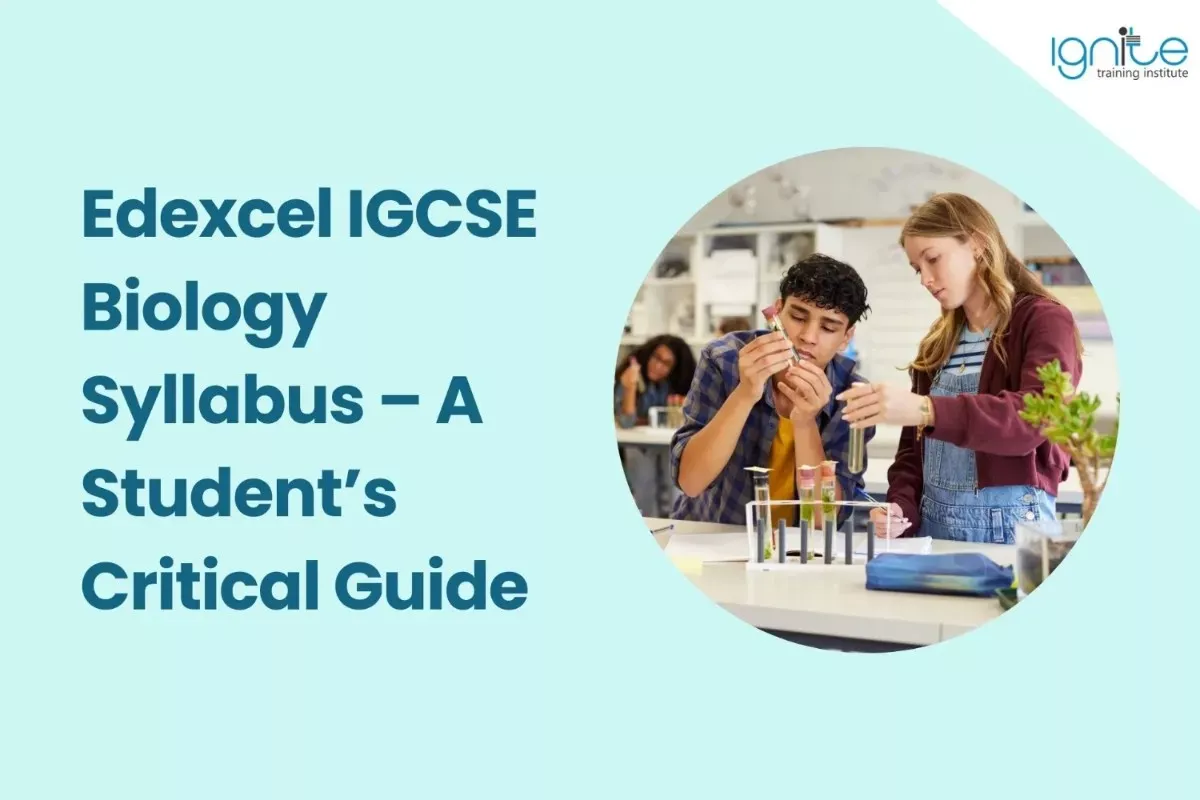
What does the Edexcel IGCSE Biology syllabus cover? The Edexcel IGCSE Biology syllabus, specification code 4BI1, covers five topic areas and is assessed by two written papers: Paper 1 (2 hours, 110 marks) and Paper 2 (1 hour 15 minutes, 70 marks). It is graded 9 to 1, has no coursework and has no tiers.
The specification is the document every exam question is written from, so students who know it well revise with far more direction. Our IGCSE Biology tutors in Dubai teach from it lesson by lesson. This guide explains the syllabus topics, the two papers, recent grade boundaries and a study plan that works, with every figure taken from Pearson’s own documents.
Key Summary
- Specification code: 4BI1, awarded by Pearson Edexcel. The current version is Issue 3, published in September 2024.
- Content: Five topic areas, from the variety of living organisms to the use of biological resources.
- Assessment: Paper 1 is worth 61.1% and Paper 2 is worth 38.9%. Both are written exams, with a total of 180 marks.
- Grading: 9 to 1. In June 2026, grade 9 needed 142 marks out of 180 and grade 4 needed 67.
- Practical work: There is no practical exam. Practical skills are tested inside the written papers.
What Is Edexcel IGCSE Biology?
Edexcel IGCSE Biology is the name most schools use for the Pearson Edexcel International GCSE in Biology. It is a linear course, usually taught over two years to students aged 14 to 16, with both papers taken in the same exam series at the end. It is one of the qualifications covered in our guide to Pearson Edexcel IGCSE.
| Aspect | Edexcel IGCSE Biology (4BI1) |
|---|---|
| Awarding body | Pearson Edexcel |
| Specification code | 4BI1 |
| First teaching | September 2017 |
| First assessment | June 2019 |
| Structure | Two written papers, linear, untiered |
| Exam series | June and November |
| Total marks | 180 (110 + 70) |
| Grading | 9 to 1 |
| Coursework | None |
| Calculator | Allowed in both papers |
What The Code 4BI1 Means
4BI1 is the code schools use when they enter students for the exams. The two papers are coded 4BI1/1B (Paper 1) and 4BI1/2B (Paper 2). Paper 1 is also shared with the International GCSE Science Double Award, where it carries the code 4SD0/1B. Pearson also offers a separate modular International GCSE in Biology. This guide covers the linear 4BI1 course, which is the one most schools teach.

Edexcel IGCSE Biology Syllabus: The 5 Topic Areas
The Edexcel IGCSE Biology syllabus is organised into five topic areas. Questions in both papers can come from any of the five, so no topic can be left out of revision.
1. The Nature And Variety Of Living Organisms
The characteristics shared by living organisms, and the main groups: plants, animals, fungi, protoctists, bacteria and viruses.
2. Structures And Functions In Living Organisms
The largest topic. It covers levels of organisation, cell structure, biological molecules, movement of substances into and out of cells, nutrition, respiration, gas exchange, transport, excretion, and coordination and response.
3. Reproduction And Inheritance
Reproduction in flowering plants and humans, followed by inheritance: genes, DNA, monohybrid crosses, variation, mutation and natural selection.
4. Ecology And The Environment
Organisms in their environment, feeding relationships, cycles within ecosystems and human influences on the environment. Fieldwork methods such as quadrat sampling are taught here.
5. Use Of Biological Resources
Food production, selective breeding, genetic modification and cloning. Questions in this topic often apply biology to farming and industry.
Edexcel IGCSE Biology Specification: How To Read It
The specification is free to download from Pearson and is the most useful revision document a student can own. Three features are worth understanding.
Bold Statements With A B Reference
Statements printed in bold with a B reference are tested only in Paper 2. Everything else can appear in either paper. A student revising for Paper 1 can therefore set the bold content aside until the core content is secure.
Practical Investigations In Italics
Practical investigations appear in the content as statements in italics, and Appendix 6 of the specification lists suggested practicals. There is no separate practical exam. The written papers test whether students can plan an experiment, identify variables, read results and evaluate a method.
Assessment Objectives
Pearson publishes the balance of marks across three assessment objectives.
| Assessment objective | What it tests | Weighting |
|---|---|---|
| AO1 | Knowledge and understanding of biology | 38 to 42% |
| AO2 | Application, analysis and evaluation | 38 to 42% |
| AO3 | Experimental skills, and analysis and evaluation of data and methods | 19 to 21% |
About 60% of the marks therefore reward applying knowledge and handling experiments and data, not recall alone. This is why students who only memorise notes often score below their expectations.
Edexcel IGCSE Biology Paper 1 And Paper 2
| Feature | Paper 1 (4BI1/1B) | Paper 2 (4BI1/2B) |
|---|---|---|
| Duration | 2 hours | 1 hour 15 minutes |
| Marks | 110 | 70 |
| Weighting | 61.1% | 38.9% |
| Content | Core content from all five topics, without the bold B statements | All content, including the bold B statements |
| Question types | Multiple choice, short answer, calculations and extended open response | Multiple choice, short answer, calculations and extended open response |
Paper 1 carries most of the marks, so secure core knowledge matters most. Paper 2 is shorter but can test the extra bold content, and many students find its timing tighter. Both papers are untiered, which means every student sits the same paper and can reach any grade from 9 to 1.
Need A Clear Plan For Paper 1 And Paper 2?
Talk to an Ignite academic advisor about your child’s current grade, weak topics and a realistic target before mock exams.
Talk To An Academic AdvisorEdexcel IGCSE Biology Grade Boundaries
A grade boundary is the minimum mark needed for a grade. Pearson sets the boundaries after each exam series, so there is no fixed percentage for any grade. These are the published boundaries for papers 1B and 2B, out of 180 marks.
| Grade | June 2026 | November 2025 | June 2025 |
|---|---|---|---|
| 9 | 142 | 130 | 140 |
| 8 | 127 | 115 | 124 |
| 7 | 112 | 100 | 109 |
| 6 | 97 | 86 | 94 |
| 5 | 82 | 73 | 79 |
| 4 | 67 | 60 | 65 |
In the last two June series, grade 9 needed about 78 to 79% of the marks and grade 4 about 36 to 37%. Some regions sit papers with an R in the code (1BR and 2BR), which have their own boundaries. Use past boundaries as a guide for mock exams, not as a prediction, and see our guide to Edexcel IGCSE grade boundaries for other subjects.
How To Study For Edexcel IGCSE Biology
- Use the specification as a checklist. List every statement, rate your confidence in each one and update the list every few weeks.
- Start past papers early. Begin with topic questions in the first year of the course and move to full timed papers in the second. Mark each one with the official mark scheme and note the exact wording that earns marks.
- Learn the practicals properly. For each investigation, know the method, the independent, dependent and control variables, the equipment and the likely sources of error.
- Learn the command words. Describe, explain, compare and evaluate each ask for a different kind of answer. Appendix 5 of the specification defines all of them.
- Read examiner reports. Pearson publishes a report after each series that shows where students lost marks.
For a wider revision routine across all subjects, see our guide on how to study for IGCSE.
Where Students Lose Marks
- Vague wording: Writing that the body absorbs nutrients when the mark scheme wants the small intestine and the method of absorption.
- Ignoring the command word: Describing a trend when the question asks for an explanation.
- Weak data answers: Stating what a graph shows without using figures from it or linking it to the biology.
Is Edexcel IGCSE Biology Hard?
Edexcel IGCSE Biology has a large amount of content, and most of the marks need more than recall. Students usually find three areas hardest: inheritance questions that need careful genetic diagrams, the organ systems in Topic 2 because of the volume of detail, and practical questions about unfamiliar experiments. All three improve with regular past paper practice. If your child’s school follows the other main board, our Cambridge IGCSE Biology guide explains how that syllabus differs.
After Edexcel IGCSE Biology: A-Level And University
Edexcel IGCSE Biology prepares students for A-Level Biology and for the IB Diploma. Sixth forms often ask for a strong grade, commonly a 6 or 7, to start A-Level Biology, and each school sets its own requirement. Our A-Level tutors in Dubai teach both Edexcel and Cambridge Biology.
Universities look mainly at A-Level or IB results, but competitive courses such as Medicine and Biomedical Sciences may also check IGCSE science grades. Entry requirements differ by university, so check each course page. Our list of universities that accept the IGCSE certificate gives an overview.
Where To Find Official Edexcel IGCSE Biology Resources
- Specification and sample papers: On Pearson’s International GCSE Biology (2017) page.
- Past papers and mark schemes: In the course materials on the same page. The most recent series is locked for teachers for a period after the exams.
- Examiner reports: Published with the past papers for each series.
- Grade boundaries: On Pearson’s grade boundaries page, listed by exam series.
Edexcel IGCSE Biology Tutoring In Dubai
Ignite Training Institute teaches Edexcel and Cambridge IGCSE Biology in one-to-one and small-group lessons, at our Dubai centres and online. Lessons follow the 4BI1 specification statement by statement, with past paper questions and mark scheme practice for both papers. Students who need help across several subjects can also work with our IGCSE tutors in Dubai.

FAQs
1. What Is The Edexcel IGCSE Biology Specification Code?
The code is 4BI1. The paper codes are 4BI1/1B for Paper 1 and 4BI1/2B for Paper 2.
2. How Many Papers Are In Edexcel IGCSE Biology?
There are two written papers. Paper 1 lasts 2 hours and is worth 110 marks, or 61.1% of the grade. Paper 2 lasts 1 hour 15 minutes and is worth 70 marks, or 38.9%.
3. What Topics Are In The Edexcel IGCSE Biology Syllabus?
There are five: the nature and variety of living organisms, structures and functions in living organisms, reproduction and inheritance, ecology and the environment, and use of biological resources.
4. Is Edexcel IGCSE Biology Harder Than Cambridge IGCSE Biology?
Neither is harder overall. Edexcel has two untiered papers and no practical exam. Cambridge has Core and Extended routes and a practical or alternative to practical paper. Universities treat the two equally.
5. What Grade Is A Pass In Edexcel IGCSE Biology?
Grade 4 is generally treated as a standard pass. Many sixth forms ask for a higher grade to study Biology at A-Level.
6. Is There A Practical Exam In Edexcel IGCSE Biology?
No. Practical skills are tested through questions in the two written papers, based on the investigations listed in the specification.
7. When Are Edexcel IGCSE Biology Exams Held?
The current specification lists two exam series a year, June and November. Schools choose which series they enter.
Conclusion
The Edexcel IGCSE Biology syllabus is clearly defined: five topic areas, two papers and a specification that states exactly what can be examined. Students who work from that document, practise past papers from the first year and learn how marks are awarded give themselves the best chance of a top grade.
Want Structured Help With Edexcel IGCSE Biology?
Book a free demo class with an Ignite Biology tutor and get a study plan built around the 4BI1 specification and your child’s target grade.
Book A Free Demo ClassSources
- Pearson, International GCSE Biology (2017) qualification page: https://qualifications.pearson.com/en/qualifications/edexcel-international-gcses/international-gcse-biology-2017.html
- Pearson, International GCSE in Biology (4BI1) specification, Issue 3, September 2024: https://qualifications.pearson.com/content/dam/pdf/International%20GCSE/Biology/2017/specification-and-sample-assessments/international-gcse-biology-2017-specification1.pdf
- Pearson, International GCSE grade boundaries, June 2026: https://qualifications.pearson.com/content/dam/pdf/Support/Grade-boundaries/International-GCSE/grade-boundaries-june-2026-international-gcse.pdf
- Pearson, International GCSE grade boundaries, November 2025: https://qualifications.pearson.com/content/dam/pdf/Support/Grade-boundaries/International-GCSE/2511-international-gcse-subject-grade-boundaries.pdf
- Pearson, International GCSE grade boundaries, June 2025: https://qualifications.pearson.com/content/dam/pdf/Support/Grade-boundaries/International-GCSE/grade-boundaries-june-2025-int-gcse.pdf

Categories:
November 2


IGCSE Maths Exam Preparation: Common Mistakes & Last-Minute Fixes
August 5
Cambridge IGCSE Physics 0625: Syllabus, Papers & Past Papers
August 5